Yes, but the connection method determines what you gain. One portable power station can charge another through a compatible charging input. Certain models can also combine their outputs through manufacturer-approved equipment. These are different arrangements: charging one unit from another does not automatically add their output wattages together.
If your goal is longer runtime, battery expansion or using the units separately may be more useful. If you need more power for one appliance, you need a system specifically designed to provide that higher output.
Charging One Power Station From Another
A common arrangement uses the first unit’s AC outlet to supply the second unit’s normal AC charging cable:
Unit A’s AC output → Unit B’s charging input
Unit A acts as the electricity source, while Unit B receives power through its charging system. This is often called daisy-chaining.
For this to work, Unit A’s output must meet Unit B’s charging requirements, including voltage, frequency, and available power. Use the receiving unit’s specified charging cable or adapter.
Charging speed matters here. A power station that charges comfortably from a wall outlet may demand more power than a smaller unit can supply. Where adjustable AC charging is available, reducing the receiving unit’s charging rate can keep the demand within the supplying unit’s continuous output limit. Account for anything else connected to the source as well.
The connection transfers energy between the units. It does not turn two 1,000W power stations into a single 2,000W supply.
What changes when you charge and use the second unit simultaneously?
Some power stations support simultaneous charging and output, but the internal power path varies.
In AC bypass mode, incoming AC electricity passes through to the connected appliances. The first power station may therefore need to supply both the second unit’s battery charging and its appliance loads.
For illustration, if charging draws 400W and a connected appliance draws 300W, the supplying unit may need to deliver approximately 700W, plus operating overhead. Setting a 400W battery-charging limit does not necessarily limit total incoming power to 400W.
The receiving unit’s bypass rating can also differ from its battery-powered output rating. Check that specification rather than assuming the number printed beside its inverter rating applies in every operating mode.
How much energy is lost?
When energy moves from Unit A’s battery into Unit B’s battery through an AC connection, it undergoes DC-to-AC conversion followed by AC-to-DC conversion. Both stages consume some energy.
There is no single loss percentage that applies to every pair of power stations. Charging rate, conversion efficiency, and the equipment’s own consumption all affect the result. If Unit B supplies an appliance through AC bypass, that portion of the incoming electricity follows a different path from electricity being stored in its battery.
Daisy-chaining can be useful when you need energy in a particular unit, but transferring energy between batteries adds losses that direct use can avoid.
Combining Output Requires a Supported System
To increase the power available to one load, the equipment must coordinate the units’ AC outputs. An ordinary charging cable cannot do that.
Matching voltage labels are insufficient. Two independent outlets marked 120V and 60Hz are not necessarily synchronized. Connecting their outputs together with an improvised cable can damage the equipment and create an electrical hazard. Do not join AC outlets together or treat a power strip as an output combiner.
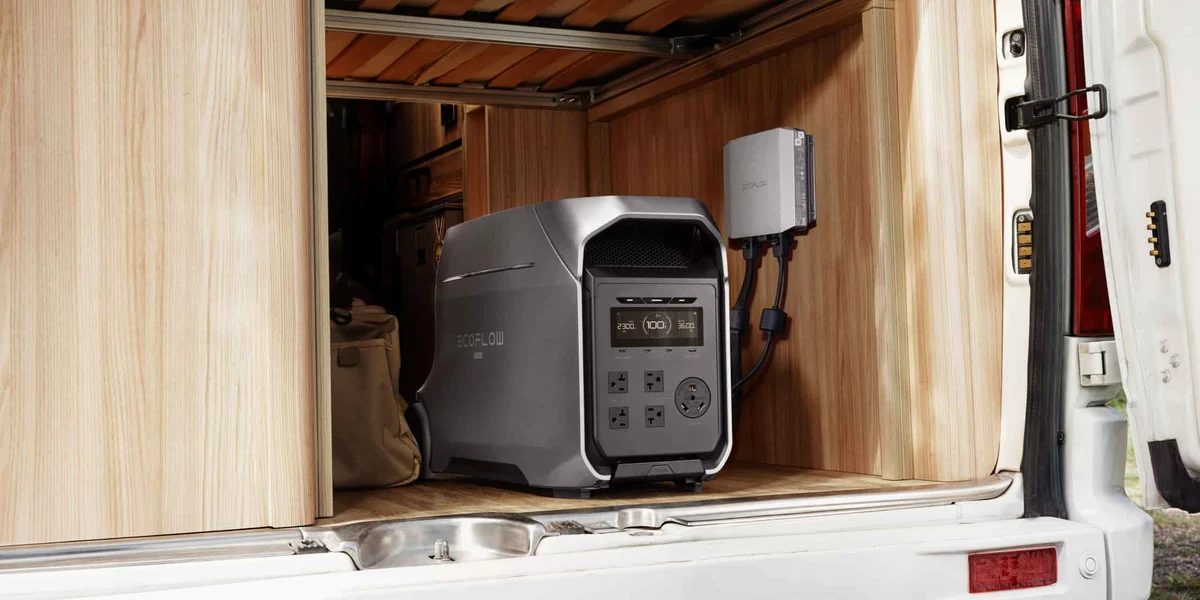
Supported combinations use dedicated hardware and specified models. For example, two original EcoFlow DELTA Pro units can connect through the compatible Double Voltage Hub to provide up to 7,200W and 240V output. That is a capability of that particular configuration, not a general feature of two portable power stations.
The resulting voltage matters as much as the combined wattage. A 240V output is not suitable for a 120V-only appliance, and the system’s total rating does not mean every individual outlet can deliver that entire amount.
An Expansion Battery Is Different From a Second Power Station
An expansion battery connects through a designated battery interface and is managed as part of the supported system. It adds stored energy without requiring the AC charging arrangement described above.
A second complete power station has its own charging electronics and inverter. Even if its expansion connector looks identical, it cannot be assumed to function as an extra battery for another unit. The manufacturer must explicitly support that pairing.
If you are choosing a power station with future expansion in mind, check whether “expandable” means additional battery capacity, combined AC output, or both. Those capabilities solve different problems.
Additional battery capacity generally helps a supported appliance run longer. It does not automatically raise the main unit’s inverter output limit. If an appliance already exceeds that limit, adding stored energy alone will not resolve the mismatch.
Using Two Units Separately May Be More Practical
If you already own two power stations, connecting them is not always necessary.
You can divide appliances between them, keeping each unit within its own output limits. This uses both batteries without transferring energy from one into the other. It also lets you position each unit near the equipment it supplies.
For a single appliance, another option is to use one unit and then move the appliance’s plug to the second. That introduces a power interruption, so it suits equipment that can tolerate being switched off briefly.
Neither approach increases the wattage available to one appliance. However, both can make use of the energy you already own without needing a compatible expansion system.
Conclusion
Identify the limitation before choosing a connection. If an appliance runs properly but the battery empties too soon, focus on runtime. If the unit cannot start or sustain the appliance, focus on output capability. Charging one power station from another can transfer energy, but overcoming an output limit requires a supported combining system or a more capable individual unit.

James is the creative mind behind worthelevate.com, with 4 years of experience writing hilarious puns, including food puns and animal puns. His witty articles add humor to everyday topics, making him a go-to for those seeking a fun twist on their favorite meals and animals.