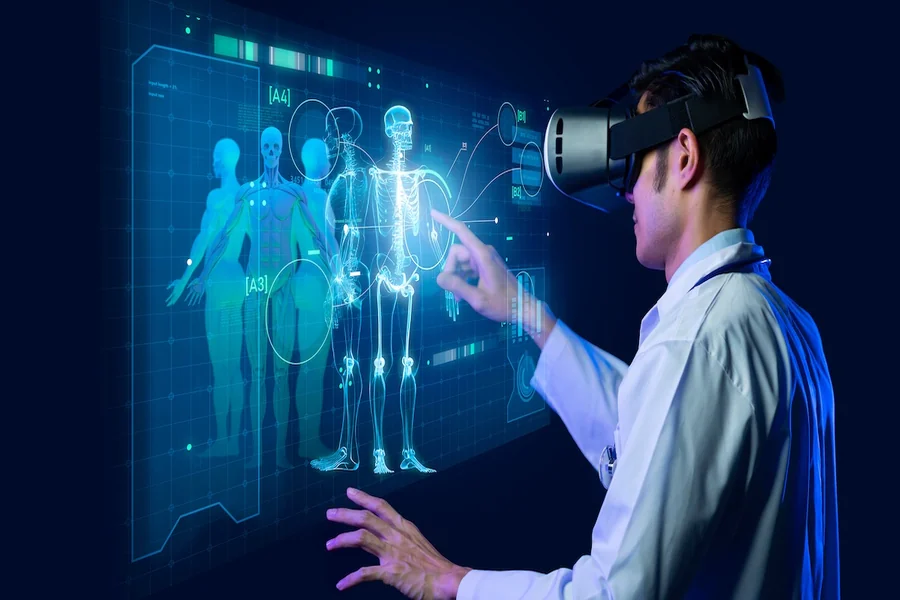
Healthcare technology is defined as any technology used to enhance the delivery and management of health care services through digital tools, medical devices, software, artificial intelligence, data systems, and connected technologies. It supports doctors in a variety of ways including diagnosis, patient monitoring, retrieval of medical records, patient communication and the making of informed treatment decisions. This is a revolution in healthcare, driven by technology that makes services more accessible, data-driven, efficient, personalized, and presents new challenges regarding privacy, cost and security.
Knowledge, experience and careful decision making have always been the basis of healthcare. In today’s day and age, technology has become another important part of that. Digital systems are facilitating physicians and other healthcare workers to gather and understand data quicker and more easily, and to track patients outside of the hospital or clinic setting.
This effect is seen in the day-to-day care. Patients can video chat with doctors, get test results online, and have access to wearable devices for tracking health-related data. Meanwhile, hospitals are leveraging AI, cloud solutions, robotics, and EHRs to enhance clinical and administrative processes.
Technology is not taking the place of a health care worker. Rather, it’s modifying their behaviors and patient interaction with the health care system. Learning about these changes can assist patients, health care workers, and businesses to be prepared for the future.
Digital Healthcare Is Making Care More Accessible
Easier access to medical services is one of the largest ways that technology is changing healthcare. In previous times patients had to head to a doctor’s office or hospital. For people, particularly in rural areas, older adults, people with mobility issues or patients requiring multiple follow-up appointments, this may be challenging.
This is no longer the case with telemedicine. Through the use of video calls, telephone consultation and secure messaging platforms, patients can now consult healthcare professionals. Although virtual care isn’t always acceptable for all medical conditions, it can be helpful for many routine consultations and follow-ups.
Digital healthcare can also minimize unnecessary travel and waiting time. A patient can talk to a doctor remotely about symptoms, and if they’re unsure if a physical exam is necessary.
This shift is also reflected in mobile health apps. There are numerous apps that can be used to record appointments, medication, exercise, sleep patterns, nutrition and other health-related data. These tools can help to empower individuals to be more involved in their health management.
But, not all access is equal. Internet, a smartphone, digital skills and low cost Internet services are still required. When technology enters the healthcare industry, these barriers should come into consideration.
AI is transforming diagnosis and treatment.AI is driving change in diagnosis and treatment.
Artificial Intelligence Is Changing Diagnosis And Treatment
Artificial Intelligence or AI is playing a vital role in today’s healthcare. AI systems can handle vast quantities of data and identify patterns that might be hard to see by human inspection.
A significant application is medical imaging. Medical professionals can use AI tools to help analyse X-rays, CT scans, MRIs, and more. They can assist in recognizing the signs that need to be investigated. The idea is not to let a machine diagnose a patient, it’s to provide the clinician with another instrument to examine complex data.
AI is also being harnessed in drug discovery and personalized treatment. Algorithms can be applied to biological data to find possible links between disease, genes and therapies.
Other possible applications are:
- Facilitating early detection of some diseases
- Data analysis of big health data sets
- Assisting physicians to diagnose a patient’s risk level
- Streamlining repetitive administrative tasks in the process
- Supporting clinical decision-making
- Recognizing possible drug interactions
- Building a more efficient hospital scheduling and resource planning system
AI has immense potential but must be used responsibly. Making health decisions can impact lives, so accuracy and accountability is important. The AI system may also generate wrong or biased outcomes when it is trained on limited or biased data.
Thus, human expertise is still needed. Healthcare professionals should be aware of when an AI recommendation is useful, and when it should be questioned.
Wearable Devices Are Bringing Health Monitoring Into Daily Life
Wearable tech is another key component of healthcare change. Health parameters can be measured around the clock with a device like smartwatches or fitness trackers, connected sensors, etc.
Users can track metrics like heart rate, physical activity, sleep data or blood oxygen saturation, depending on the device. Certain specialized devices can also track particular medical problems.
Wearable technology is more than a number collector. Regular or continuous monitoring provides additional information regarding changes over time to patients and health care professionals.
For instance, a measurement taken at one time during a clinic visit can only tell you about one moment in time. Patterns may not be apparent during one day or week, but can be seen after several days or weeks.
For individuals with chronic conditions, remote patient monitoring can be particularly beneficial. Relevant information can be shared with healthcare teams without the need for patients to interact with a health care facility on a more frequent basis.
However, there are still drawbacks to wearable devices. Consumer devices are not always intended to substitute for clinical devices. Sometimes their readings are incorrect and users may be unnecessarily concerned by normal variations in their data.
In a sense, the aim of wearable tech is to better inform health care, not to invite self-diagnosis.
Electronic Health Records and Data Are Improving Healthcare Coordination
Huge amount of information is created in the healthcare industry. Medical histories and prescriptions, lab results, imaging reports, allergies, and treatment plans must all be documented and readily available when needed.
Many paper-based processes have been replaced by electronic health records (EHRs). They enable authorized health care practitioners to store and retrieve patient information electronically.
With a proper approach, EHR systems can facilitate coordination in healthcare. A physician may be able to look at previous laboratory tests to make a treatment decision. A Pharmacist will have access to relevant prescription information. Information can be shared more effectively between different departments.
Healthcare research and planning can also be aided by data. Researchers can use large datasets to learn more about the disease, patterns, and treatments. Operational data can be analysed to gain insight into demand and how staff and resources are being used in hospitals.
But health information is very sensitive. It is important to have robust security measures in place. Patient information should be kept confidential and secure from unauthorized access, data breaches, and misuse.
Another significant challenge is interoperability. Healthcare systems don’t always operate seamlessly. Digital records can be limited by information being locked within different systems.
Collecting more information is not the only future of healthcare data, it also has to be accurate, secure, accessible and useful.
Robotics, Automation, And Connected Technology Are Reshaping Hospitals
Technology is also transforming the hospital and clinic environment. Tasks which require precision, repetition or efficient movement are being performed using robotics and automation.
For surgical applications, robotic systems can assist surgeons in complex surgeries using specialty instruments. These systems aren’t always independent as science fiction often depicts. The surgeon is often in charge of the technology and the technology is used to enable precision and visualization.
Outside the operating room, automation is useful, too. Automated systems can be utilized for appointment scheduling, inventory management, billing, lab operations, and various other administrative duties in hospitals.
Medical devices that are connected can give the healthcare team information from the equipment and patient-monitoring systems. An organization can make better and quicker decisions when various technologies are put to work.
This transformation can also help to ease the burden of administrative workload on healthcare professionals. When tasks can be automated, professionals have more time for tasks that depend on communication, judgment and interaction with others.
However, the use of automation should be done gradually. If the system is poorly designed, it can result in additional work, not less. It’s all about staff training and ease of use as well as technology.
The Challenges of Technology in Healthcare
While technology is extremely beneficial, it poses significant threats and challenges as well. Healthcare organisations can’t just think about the capabilities of new technology. They also need to think about if it’s safe, inexpensive, reliable, and suitable.
One of the primary concerns is privacy and cyber security. Healthcare systems are filled with highly personal information and therefore, the systems are an appealing target for a cyberattack. Efforts must be made to ensure robust security practices, to train staff, to implement access control and to regularly update the system.
Cost is another challenge. Expensive medical equipment and digital systems can be needed. Clinics and practices with fewer staff may not have enough funds for new technology or might not be able to keep up with complex technology.
Limited access also can be provided through digital inequality. Not all patients can be confident with their internet connection, digital device and ability to interact with digital healthcare platforms.
Accuracy and trust are important also. Patients should be informed of the use of technology in their care. Healthcare professionals require systems that are accessible and give them relevant information, but not confusing.
Then, there’s the human connection. Healthcare is more than data, it’s about diagnosis. Empathy, communication, reassurance and trust are required for patients. These should be enhanced by technology, not eliminated.
The best health systems are likely to integrate digital with human expertise. Technology can be fast and effective at processing information, while health care workers offer context and judgment.
Final Thoughts
The world of healthcare is changing and technology is playing a significant role in this transformation by altering the way medical services are provided, how information is handled and how patients engage with their healthcare. Access to consultations is enhanced through telemedicine. AI’s role in diagnosis and research. Wearable technology is allowing continuous monitoring, and electronic health records are aiding healthcare professionals to coordinate patient information.
While technology can help create an efficient and accessible healthcare environment, technology does not solve all healthcare issues. The privacy and cyber security, the cost and accuracy, the digital inequality, and the need for human care need to stay in the discussion.
The future of healthcare isn’t just about technology usage. It will be a matter of the proper technology deployed properly. By focusing on the patients’ needs and leveraging the expertise of professionals, digital tools can contribute to a more connected, informed, and responsive healthcare system.
The most significant change that will occur in the years to come will be technology that enhances the real healthcare experience, not technology that is just new.

James is the creative mind behind worthelevate.com, with 4 years of experience writing hilarious puns, including food puns and animal puns. His witty articles add humor to everyday topics, making him a go-to for those seeking a fun twist on their favorite meals and animals.







2 thoughts on “How Technology Is Transforming Healthcare”